Sunlit Mat Living · sunlitmatliving.com · General education only, not medical advice.
Key takeaways
- Muscle-strengthening activity is recommended for adults 65 and older on two or more days each week.
- Everyday movements like standing from a chair are practical strength builders.
- Move slowly, breathe out on the effort and never hold your breath.
- Start with a few repetitions and rest between sets.
When people hear "strength training," they sometimes picture heavy weights and gym machines. But strength has a much more everyday meaning: standing up from your favorite chair, carrying groceries, climbing the stairs, lifting a grandchild or getting out of the car with ease.
The Centers for Disease Control and Prevention recommends that adults 65 and older do muscle-strengthening activities on two or more days a week, in addition to aerobic and balance activities, as abilities and conditions allow. Yoga includes many poses that ask your muscles to support your body weight, and with a chair or wall for help, they can be gentle and manageable.
This article is general information. If you have heart disease, high blood pressure, joint replacements, osteoporosis or other health concerns, please talk with your doctor before beginning.
Ground rules for safe strength
- Breathe out on the effort. For example, exhale as you stand up. Never hold your breath.
- Move slowly and with control. Quality beats quantity.
- Stay pain-free. Muscle effort is normal. Joint pain is not.
- Rest between sets and take a day off between strength sessions.
- Use support. A sturdy chair or wall makes it safe to challenge yourself.
Six everyday-strength movements
1. Chair sit-to-stand
Sit toward the front of a sturdy chair with feet hip-width apart, placed against a wall. Lean slightly forward, press through your heels and stand up. Pause, then sit back down slowly, taking about three seconds to lower. Begin with five repetitions. If needed, use your hands on the seat or armrests, and as you gain confidence try crossing your arms over your chest.
2. Wall push-ups
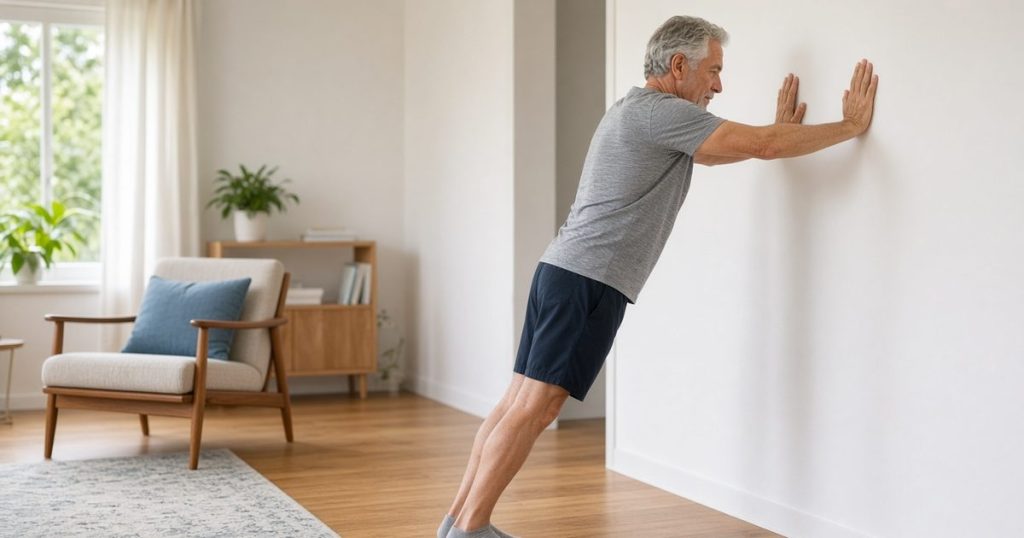
Stand an arm's length from a wall. Place your palms on the wall at shoulder height, slightly wider than your shoulders. Bend your elbows and lean in slowly, then press back to standing. Repeat eight times. Stand farther back for more challenge or closer for less. If your wrists are sensitive, rest on your forearms instead.
3. Chair pose, supported
Stand in front of a chair, feet hip-width. Bend your knees and send your hips back as though about to sit, then hover an inch or two above the seat. Hold for two or three breaths, then press up to standing. Rest your hands on a counter or the chair back for steadiness. This is a gentle version of a well-known yoga pose.
4. Warrior II arms (seated or standing)
Sit tall, or stand at the counter. Extend your arms out to the sides at shoulder height, palms down. Hold for five slow breaths, then lower. Build up to ten breaths. This challenges the shoulders and upper back, which are often overlooked.
5. Seated knee lift with a pause
Sit tall, holding the sides of the chair. Lift your right knee a few inches and hold for two breaths. Lower and switch. Repeat six times each side. This builds hip flexor and core strength.
6. Counter-supported calf raises
Holding a counter, rise onto your toes, pause for a breath, then lower slowly. Repeat ten times. Strong calves help with walking, stairs and balance. See our balance practices.
Sample 12-minute session
- Warm up with two minutes of seated marching and shoulder rolls.
- Do each of the six movements for one set, resting between.
- Repeat the circuit a second time if you feel good.
- Cool down with three slow breaths and a gentle seated stretch.
Aim for two or three non-consecutive days a week to begin with. Progress slowly. Add a repetition or a few seconds of hold time after a couple of weeks, if you feel comfortable.
How will I know I am working at the right level?
You should feel your muscles working, but you should still be able to talk and breathe comfortably. If you find yourself straining, holding your breath or shaking, reduce the number of repetitions or choose an easier variation. If you finish and feel you could easily do a lot more, add a repetition or two.
Fuel and recovery
Eating regular meals with some protein and drinking enough fluids support your muscles. See our guide to everyday eating after 60. Sleep is important too. A gentle evening routine may help.
When to stop and call for help
Stop right away if you feel chest pain or pressure, trouble breathing, dizziness, faintness, unusual pain or numbness. Call 911 for any emergency symptoms. If you feel sore for more than two days, or notice swelling in a joint, rest and speak with your doctor.
Strength is built a little at a time
Each repetition is a small vote for a more capable you. Keep it simple, keep it steady, and enjoy the satisfaction of standing up from your chair with ease.
For ideas on putting a routine together over the weeks, try our walking and yoga weekly plan.
This article is general educational information from the Sunlit Mat Living Editorial Team. It is not medical advice and is not a substitute for care from your doctor. See our Editorial Policy to learn how we research and update articles.