Sunlit Mat Living · sunlitmatliving.com · General education only, not medical advice.
Key takeaways
- Balance is a skill, and like any skill it can be practiced a little at a time.
- Always practice next to a sturdy counter, wall or chair you can hold.
- Start with two feet on the ground, then slowly try narrower stances.
- Talk with your doctor about balance concerns or a history of falls.
Most of us never think about balance until it feels a little less reliable. Maybe you wobble when you put on your socks, or you reach for the wall on a curb. The good news is that balance is a skill your body can keep practicing at any age. Yoga includes many simple standing movements that invite you to slow down and pay attention to your feet, your posture and your breathing.
According to the Centers for Disease Control and Prevention, more than one in four adults aged 65 and older falls each year. That is why public health agencies recommend balance activities as part of a weekly routine, alongside aerobic and muscle-strengthening exercise. This article shares eight gentle practices you can do at home, but it is not a substitute for personalized guidance. If you have had a fall, or you feel unsteady, please speak with your health care provider first. They may suggest a physical therapist who can tailor a plan to you.
Set up for safety first
Safety is the foundation of good balance practice.
- Stand next to a sturdy support. A kitchen counter is ideal. A heavy chair or a wall also works. Never use something that can slide or tip.
- Wear the right footwear. Go barefoot on a non-slip surface, or wear flat shoes with good grip. Avoid slippery socks on smooth floors.
- Clear the space. Move rugs, cords and pets out of the way.
- Light the room well. Good lighting helps your eyes and your inner ears work together.
- Have your phone close in case you need it.
Remember: Holding on is not cheating. It is how you build confidence. Over time, you can use less support if it feels right and safe.
Eight steady practices
1. Mountain pose with a steady gaze
Stand with feet hip-width apart, hands resting on the counter. Spread your toes gently, feel your weight in the middle of both feet, and let your shoulders relax. Choose a spot on the wall and rest your eyes on it. Take five slow breaths.
2. Weight shifts
From mountain pose, slowly shift your weight to your right foot, then to your left, as if gently rocking a boat. Keep your knees soft. Repeat ten times. This builds awareness of where your weight really is.
3. Heel raises
Holding the counter, rise slowly onto your toes, pause for a breath, and lower with control. Repeat eight to ten times. Strong calves and ankles help steady every step.
4. Toe raises
Still holding on, lift your toes while keeping your heels down. Lower slowly. Repeat eight to ten times. This wakes up the muscles at the front of the shins.
5. Tandem stance
Place your right foot directly in front of your left, heel touching toes, as if standing on a line. Hold the counter with both hands. Take five breaths, then switch feet. When this feels easy, try holding with just fingertips.
6. Supported tree pose
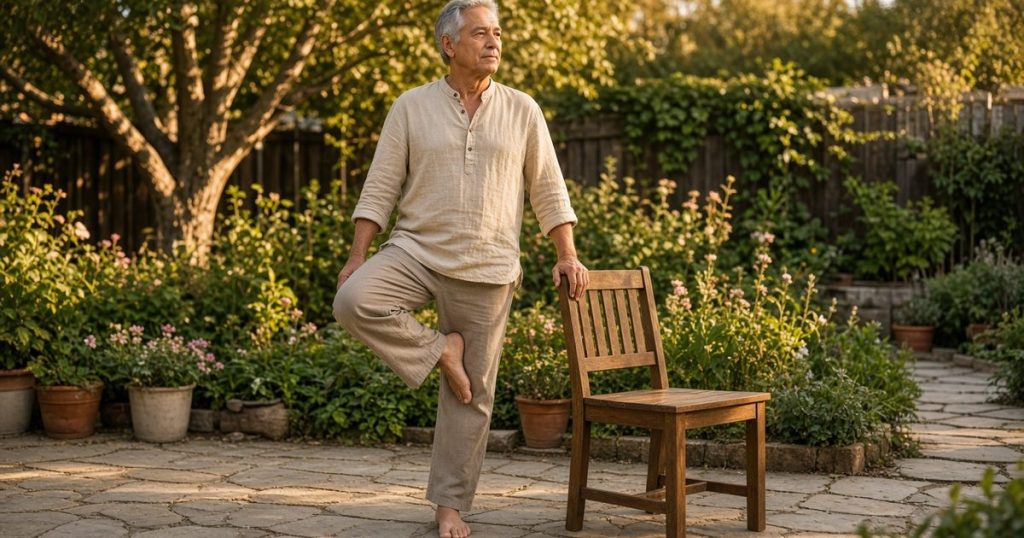
Hold the counter with your right hand. Shift your weight onto your right foot. Rest the sole of your left foot against your right ankle, calf or the floor with only your toes touching. Avoid pressing the foot against the knee joint. Hold for three to five breaths, then switch sides. Keep the lifted foot low and your hand on the counter.
7. Supported leg lift to the side
Standing tall with both hands on the counter, shift to your left foot and lift your right leg a few inches out to the side. Keep your hips level and your toes pointing forward. Hold for a breath, lower, and repeat five times. Switch legs.
8. Sit-to-stand with a pause
Sit in a sturdy chair. Cross your arms or rest your hands on your thighs. Lean slightly forward and stand up slowly, pause for a breath, then sit with control. Repeat five times. This is one of the most practical movements you can practice, since you use it dozens of times a day.
How often should you practice?
Many people find that a few minutes on most days works well, as long as they stay comfortable. Try one to three sets of a few practices, rather than rushing through all eight. Over weeks, you may notice you feel more confident. Individual results vary, and no practice can guarantee you will not fall, so keep taking sensible precautions at home.
Everyday habits that support balance
Beyond practice, small changes help keep you steady:
- Keep walkways clear and use night lights.
- Install grab bars in bathrooms if recommended.
- Wear supportive shoes indoors and out.
- Stand up slowly after sitting or lying down.
- Have your vision checked regularly and discuss any medication that causes dizziness with your doctor or pharmacist.
- Stay active with walking, which complements balance work. See our weekly walking and yoga plan.
When to get help
Please call your doctor if you notice new dizziness, you fall, you feel suddenly weak, or you notice changes in your vision or speech. For anything that feels like an emergency, call 911.
For more steady-on-your-feet ideas, see our guide to gentle strength with yoga and our article on joint-friendly hips and knees practices.
Sources and further reading
This article is general educational information from the Sunlit Mat Living Editorial Team. It is not medical advice and is not a substitute for care from your doctor. See our Editorial Policy to learn how we research and update articles.