Sunlit Mat Living · sunlitmatliving.com · General education only, not medical advice.
Key takeaways
- Gentle movement helps many people keep hips and knees feeling comfortable and mobile.
- Choose supported, low-impact movements and avoid deep bends and twists in the knee.
- Practice on a stable chair or mat, and use padding under sensitive knees.
- Speak with your doctor if you have joint pain, swelling or a joint replacement.
Hips and knees carry us through our days: stepping out of the car, climbing stairs, walking the dog, kneeling in the garden. It is no wonder they sometimes feel stiff or tired. The good news is that gentle movement is widely encouraged for adults, and yoga can offer a calm, low-impact way to keep these joints moving.
This article is general information. It is not a treatment for any joint condition. If you have joint pain, swelling, a diagnosed condition, or a hip or knee replacement, please speak with your doctor or physical therapist before starting. They can tell you which movements to avoid.
Principles for happy joints
- Move often, move gently. Joints like movement. Long periods of sitting can leave them feeling stiff.
- Stay in a comfortable range. A mild stretch is fine. Pain in the joint itself is a stop sign.
- Keep the knees safe. Avoid twisting the knee when your foot is planted, and avoid deep bending unless your provider says it is fine.
- Use support. A chair, wall or counter makes everything steadier.
- Warm up. A short walk or a few easy movements before stretching helps.
Six gentle movements
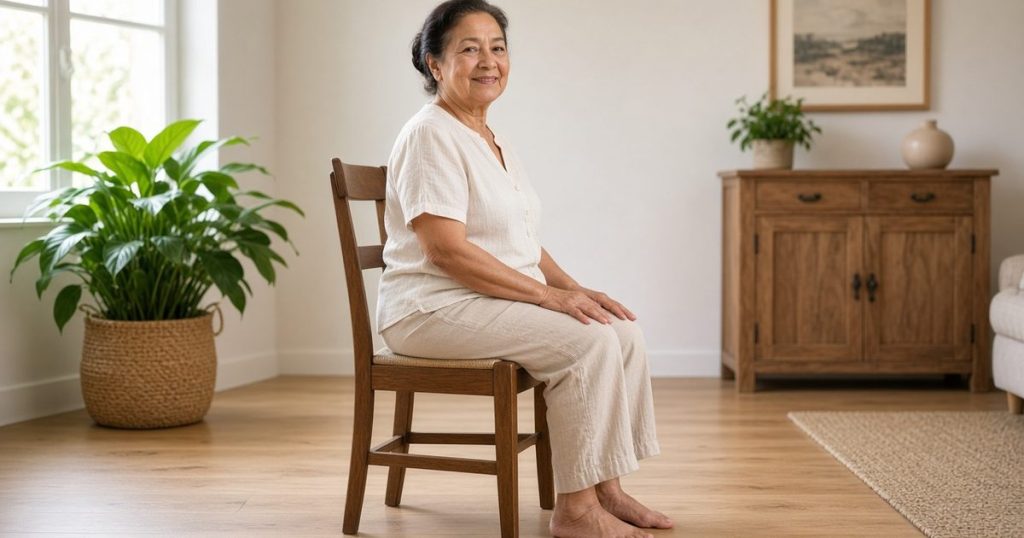
1. Seated marching
Sit tall in a sturdy chair. Lift your right knee a few inches, lower it, then lift your left. Continue slowly for 20 steps, swinging your arms if you like. This warms up the hips and thighs.
2. Seated leg extensions
Sitting tall, slowly straighten your right leg in front of you, pause for a breath, and lower with control. Repeat eight times, then switch. If your knee feels uncomfortable, reduce the range of motion.
3. Seated figure-four stretch
Sit near the front of the chair. Rest your right ankle on your left thigh, just above the knee. Keep your right foot flexed to protect the knee. Sit tall and, if comfortable, hinge forward slightly from the hips. Hold for three to five slow breaths, then switch sides. If the knee feels strained, do not press down on it. Simply rest your foot on the floor and skip the stretch.
4. Hip circles
Sitting tall, place your hands on your knees. Rotate your torso in a slow circle, as if drawing a circle with your belly button. Make five circles in each direction. Keep movements gentle.
5. Supported standing hip swings
Stand beside a counter with your right hand holding it. Shift your weight onto your right foot and swing your left leg gently forward and back, just a few inches in each direction. Repeat ten times, then turn around and switch legs. Keep your posture tall and your swing small.
6. Supported mini squats, or chair taps
Stand in front of a sturdy chair with your feet hip-width apart. Hold the counter or chair back if you need support. Bend your knees and hips slightly as though to sit, lightly tap the chair with your hips and stand. Repeat five times. Keep your knees tracking over your toes and your weight in your heels. If this is uncomfortable, make the bend smaller.
Props that help
- A folded blanket under the knees when kneeling or lying on the floor.
- A firm cushion on your chair seat to raise your hips slightly if sitting is difficult.
- A strap or belt to extend your reach in seated stretches.
Learn more about yoga props.
Movements to approach with caution
Several common yoga poses place heavy demands on the hips and knees. Without guidance, consider skipping or modifying:
- Deep kneeling or sitting on the heels.
- Cross-legged sitting on the floor for long periods, if it bothers your knees or hips.
- Full lotus or other deep hip-opening poses.
- Deep lunges and deep squats.
- Any pose that twists the knee.
A qualified teacher can show you adaptations. See how to find a class near you.
Everyday habits for comfortable joints
- Keep moving. Gentle walking is a friendly activity for many people. See our walking and yoga plan.
- Break up long sitting. Stand, stretch and move every 30 to 45 minutes.
- Wear supportive footwear with cushioning and good traction.
- Use handrails on stairs and sturdy chairs with armrests that help you stand.
- Strengthen the muscles around the joints, like the thighs and hips. See our article on gentle strength.
- Maintain a healthy weight if your doctor recommends it.
When to get help
Contact your doctor if you have joint pain that lasts, swelling, redness, warmth, a sensation of the knee giving way, locking, or new difficulty walking. Seek immediate care if you have a sudden injury, cannot bear weight, or see severe swelling or deformity. Call 911 for any emergency.
A gentle finish
Close with a few slow breaths in your chair. Rest your hands on your thighs and let your hips feel heavy and supported.
Joints enjoy kindness. A little gentle movement each day is one way to give it.
This article is general educational information from the Sunlit Mat Living Editorial Team. It is not medical advice and is not a substitute for care from your doctor. See our Editorial Policy to learn how we research and update articles.