Sunlit Mat Living · sunlitmatliving.com · General education only, not medical advice.
Key takeaways
- Gentle movement is often more comfortable than staying still for long stretches.
- Move within a pain-free range and avoid deep forward folds or strong twists unless your doctor says otherwise.
- Small posture habits matter as much as stretches.
- Speak with your doctor about back pain that is new, severe or does not improve.
Many adults notice that their lower back feels better after a short walk or a few minutes of gentle movement, and worse after sitting too long. Yoga offers a calm, low-impact way to keep the muscles around the spine moving. Research summarized by the National Center for Complementary and Integrative Health suggests yoga may help some people with low-back discomfort, though results vary, and it is not a replacement for medical care.
This article shares five gentle movements and several everyday habits that support a comfortable back. It is for general education only. If your back pain is new, severe, or accompanied by numbness, weakness, fever, or changes in bladder or bowel control, please contact your doctor promptly. If you have been told you have thin bones or osteoporosis, ask your provider which movements are safe for you, since strong forward bends and twists are often discouraged.
Before you begin
- Move slowly and stay in a comfortable range. A mild stretch is fine. Sharp or shooting pain is a signal to stop.
- Breathe steadily. Holding your breath tends to tighten muscles.
- Use a firm, non-slip surface. A carpeted floor, mat or the edge of a firm bed works well.
- Use a small pillow or folded towel for comfort under your head or knees.
Five easy movements
1. Knee rocks
Lie on your back with your knees bent and feet flat. Gently rock both knees a few inches to the right, then to the left, keeping your shoulders on the floor. Repeat eight times. The movement should be small and smooth, never forced.
2. Pelvic tilts
Lying in the same position, flatten your lower back softly toward the floor as you exhale, then release as you inhale, letting a small natural curve return. Repeat ten times. Imagine gently rocking a bowl of water without spilling it.
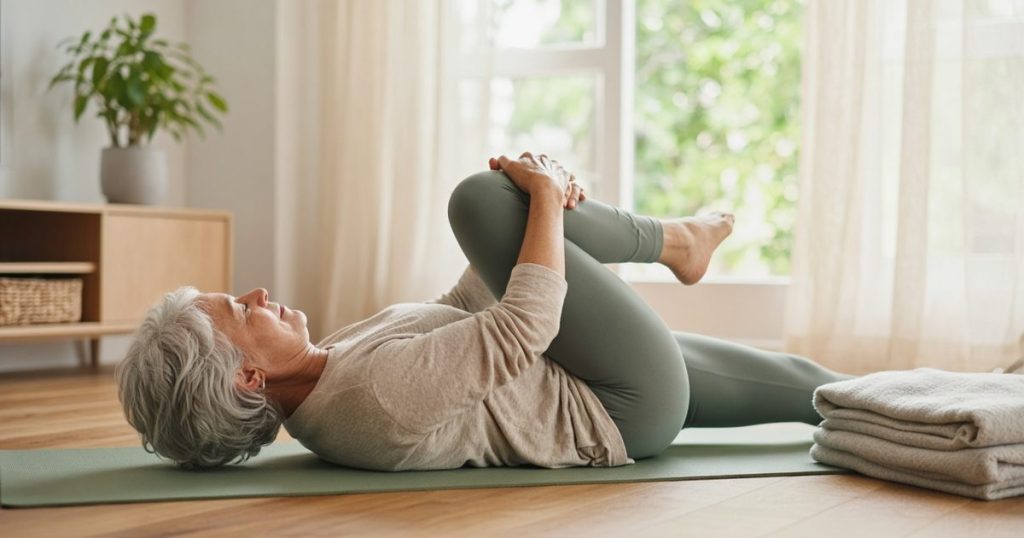
3. Single knee hug
Lying on your back, hug one knee toward your chest with both hands behind the thigh. Hold for three slow breaths and switch sides. Keep the other foot on the floor if that is more comfortable.
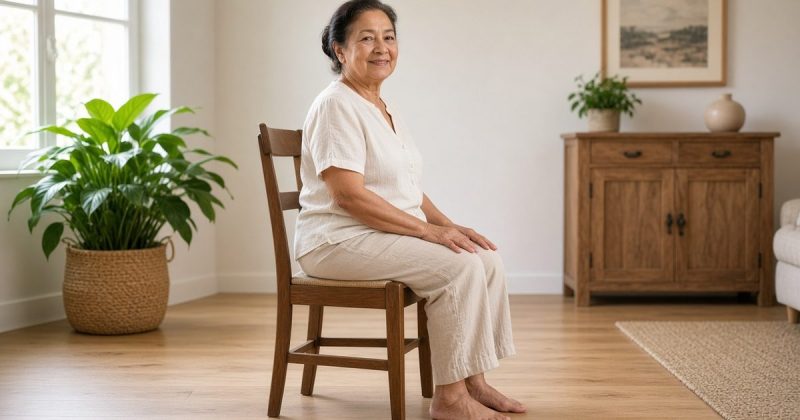
4. Seated cat and cow
Sit in a sturdy chair with your hands on your knees. Inhale as you lift your chest gently, and exhale as you round your back softly. Repeat eight times, moving slowly with your breath. This is a good option on days getting down to the floor does not appeal.
5. Supported bridge, small lift
Lying on your back with knees bent, press your feet into the floor and lift your hips just an inch or two. Pause for a breath, then lower slowly. Repeat five times. Skip it if it causes discomfort, or place a firm cushion under your hips for support.
Everyday habits that help
Stretching helps most when paired with small daily habits.
- Change positions often. Stand up and walk around every 30 to 45 minutes when you are sitting.
- Sit with support. Place a small rolled towel behind your lower back in chairs and the car. Keep feet flat.
- Lift smartly. Hold items close, bend at the hips and knees, and avoid twisting while lifting.
- Walk regularly. Easy walking is a gentle way to keep your back and hips moving. See our walking and yoga weekly plan.
- Choose a supportive mattress and pillow that let you sleep comfortably.
- Stay hydrated and rested. Fatigue can make everything feel worse.
Movements to approach with care
Some movements are often discouraged for people with back concerns or fragile bones. Ask your provider before attempting:
- Deep forward folds, especially from standing.
- Strong twists, particularly from the lower back.
- Full backbends.
- Holding long, deep stretches. Shorter holds are kinder.
Our beginner's guide offers more suggestions for modifying yoga to suit you.
When to seek medical attention
Please contact your health care provider if you notice back pain after a fall, pain that wakes you at night, pain that spreads down a leg, numbness, or weakness. Call 911 for sudden severe pain accompanied by chest pain, trouble breathing, loss of bladder or bowel control, or sudden weakness.
Finish with calm
End your session lying on your back with your knees supported by a pillow. Rest your hands on your belly and take five slow breaths. You can pair this with a simple breathing practice or an evening wind-down.
A comfortable back is built over many small, kind moments. Be patient with yourself.
This article is general educational information from the Sunlit Mat Living Editorial Team. It is not medical advice and is not a substitute for care from your doctor. See our Editorial Policy to learn how we research and update articles.