Sunlit Mat Living · sunlitmatliving.com · General education only, not medical advice.
Key takeaways
- Hands, wrists and shoulders work hard all day, and brief, gentle breaks can feel good.
- Stretch gently with no pain, and avoid forcing finger or wrist joints.
- Take a short movement break every 30 minutes during repetitive tasks.
- Speak with your doctor about numbness, tingling, swelling or persistent pain.
Think about everything your hands did today: buttoning a shirt, opening jars, turning a steering wheel, holding a phone, stirring a pot, pulling weeds. Add knitting, crocheting, painting, playing piano or typing on a tablet, and your hands, wrists and shoulders have put in a full day's work.
Gentle stretching and movement breaks may help these areas feel looser and more comfortable. This article offers a seated routine you can fit between activities. It is general educational information only. If you have persistent pain, swelling, numbness or tingling, or have been diagnosed with a hand or wrist condition, please speak with your doctor or a hand therapist before starting.
The golden rules
- Gentle only. You should feel a mild stretch, never pain, pinching or tingling.
- Warm first. Warm water over your hands for a minute can make movement more comfortable.
- Keep your shoulders relaxed. Many of us hold tension up near the ears without noticing.
- Breathe. A slow breath makes every stretch kinder.
- Little and often. Two minutes several times a day is better than one long session.
The routine (about 8 minutes)
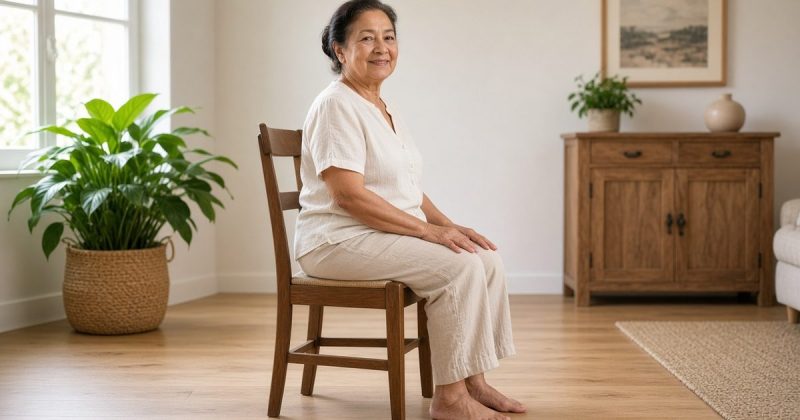
Sit tall in a sturdy chair with your feet flat on the floor.
1. Shoulder shrugs and rolls (1 minute)
Lift your shoulders toward your ears as you inhale, then let them drop with a sigh. Repeat five times. Then roll your shoulders backward five times.
2. Finger spreads (1 minute)
Rest your hands on your thighs. Spread your fingers wide as if reaching for something, then relax them. Repeat eight times. Move only as far as is comfortable.
3. Gentle fist and open (1 minute)
Slowly close your hands into soft fists, then open them wide. Repeat eight times. Do not squeeze hard.
4. Wrist circles (1 minute)
Hold your arms out in front with elbows slightly bent. Make slow circles with your wrists five times in each direction. Keep movements small if your wrists are sensitive.
5. Prayer stretch (1 minute)
Bring your palms together in front of your chest, fingers pointing up. Gently lower your hands toward your waist until you feel a mild stretch in the wrists and forearms. Hold for three slow breaths. Do not force the stretch. Release and shake out your hands.
6. Reverse prayer, or backs of hands (1 minute)
Place the backs of your hands together in front of your chest, fingers pointing down. Hold for three breaths. If that is uncomfortable, simply rest the backs of your hands on your thighs and gently curl your fingers.
7. Forearm stretch (1 minute)
Extend your right arm in front of you with your palm up. Use your left hand to gently draw the fingers of your right hand down and back, as if stretching a spring. Hold for three breaths, keeping the elbow soft. Switch sides.
8. Eagle arms, easier version (1 minute)
Hug yourself, with your right arm over your left, hands on your shoulder blades or upper arms. Breathe for three slow breaths, feeling the stretch across your upper back. Switch arms. Release if you feel any discomfort in your shoulders.
Setting up for comfort during activities
Small adjustments often help as much as stretching.
- Gardening: Use tools with padded, larger handles. Take short breaks. Alternate tasks to avoid repeating the same grip.
- Knitting and crafts: Stop every 20 to 30 minutes, stretch your fingers, and keep your wrists relaxed rather than bent.
- Tablets and phones: Rest your device on a stand or pillow instead of holding it for long periods. Use both hands and keep your wrists in a neutral position.
- Typing and writing: Keep your elbows near your sides, shoulders relaxed, wrists straight. Use a chair that supports your back.
- Cooking: Use sharp knives, since dull ones require extra force. Keep jar openers and other helpful gadgets handy.
Shoulder-friendly habits
- Keep frequently used items at waist-to-shoulder height so you do not have to reach overhead.
- Carry bags close to your body or spread weight evenly.
- When you notice yourself hunching, roll your shoulders back and take a slow breath.
What to avoid
Skip any movement that causes pain, tingling or numbness. Avoid bearing weight on your hands in floor poses, such as plank or downward-facing dog, unless your doctor or an instructor has cleared you and shown you modifications. The chair-based poses in this article avoid that pressure on the wrists.
When to see a doctor
Please contact your health care provider if you notice numbness or tingling in your fingers, swelling or redness in a joint, loss of grip strength, pain that wakes you at night, or changes that do not improve. Seek emergency care if you have sudden weakness, trouble speaking, drooping of the face, or chest pain.
Putting it together
Pair this routine with our chair yoga routine for a complete seated session, or use it as a quick break during your day. For more calm, finish with a few slow breaths.
Your hands have done a lot for you. A few moments of gentle care is a lovely way to say thank you.
This article is general educational information from the Sunlit Mat Living Editorial Team. It is not medical advice and is not a substitute for care from your doctor. See our Editorial Policy to learn how we research and update articles.