Sunlit Mat Living · sunlitmatliving.com · General education only, not medical advice.
Key takeaways
- Chair yoga lets you stretch, breathe and relax without getting down on the floor.
- This routine uses eight simple movements and takes about 12 minutes.
- Use a sturdy chair without wheels, placed against a wall.
- Move slowly, keep breathing, and skip anything that does not feel right.
Chair yoga is exactly what it sounds like: yoga movements done while seated in, or standing beside, a chair. It is a popular choice for adults who want gentle movement without worrying about getting up and down from the floor. It also works well for anyone who feels steadier with extra support.
This routine takes about 12 minutes. Read it through once, then follow along at your own pace. There is no hurry and no prize for going deeper.
Set up your space
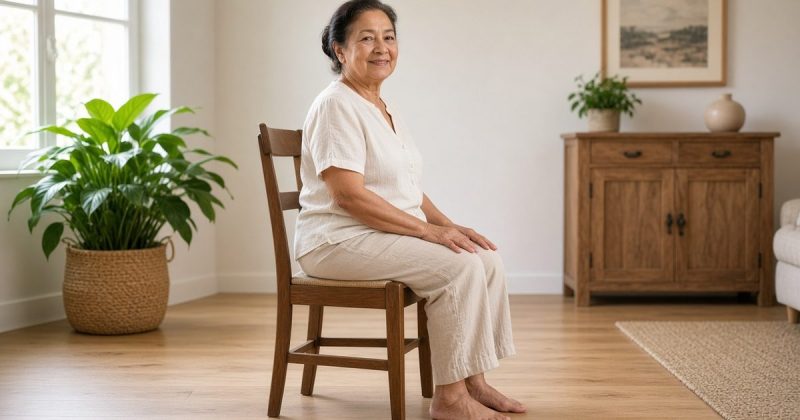
- Choose the right chair. Pick a sturdy, armless chair with a flat seat and no wheels. A kitchen or dining chair is ideal.
- Place it safely. Put the chair against a wall, or on a rug with a non-slip pad, so it cannot slide.
- Check your clothing. Wear loose, comfortable clothing and flat, supportive shoes or grippy socks.
- Keep water nearby and give yourself clear floor space.
Tip: Sit toward the front half of the seat with your feet flat on the floor, knees roughly over your ankles. If your feet do not reach, rest them on a firm cushion or folded towel.
The routine
1. Seated mountain (1 minute)
Sit tall, with your spine long and your shoulders relaxed. Rest your hands on your thighs. Close your eyes if that feels comfortable. Inhale slowly through your nose, then exhale softly. Take five easy breaths.
2. Shoulder rolls (1 minute)
Lift your shoulders up toward your ears, roll them back and down. Repeat five times. Then reverse the direction for five more.
3. Seated cat and cow (2 minutes)
Place your hands on your knees. As you inhale, gently lift your chest and look slightly forward. As you exhale, round your back and tuck your chin toward your chest. Move slowly with your breath for six to eight rounds. Keep the movement small if your neck or back feels tender.
4. Gentle side stretch (2 minutes)
Rest your left hand on the chair seat or on your thigh. Inhale and raise your right arm out to the side and overhead. As you exhale, lean softly to the left. Stay for three slow breaths. Come back up with an inhale and switch sides. Keep your hips planted on the seat.
5. Seated twist (2 minutes)
Sit tall. Place your right hand on your left knee and your left hand on the back of the chair. On an exhale, turn gently to the left, leading with your chest rather than cranking from the lower back. Hold for three breaths. Release and repeat on the other side. Twist only as far as feels easy.
6. Seated forward fold (1 minute)
With your feet flat and hip-width apart, inhale to lengthen your spine. As you exhale, hinge forward from your hips and let your hands slide down your thighs toward your knees, shins or the floor, whichever is comfortable. Keep your back long and your head relaxed. Take three breaths, then roll up slowly, head last. Skip this one if you have been told to avoid bending forward, or if you feel dizzy.
7. Ankle and wrist circles (1 minute)
Lift your right foot slightly off the floor and draw slow circles with your ankle, five each way. Switch feet. Then stretch out your arms and circle your wrists five times in each direction.
8. Resting breath (2 minutes)
Rest your hands in your lap. Breathe in through your nose for a count of four. Pause briefly. Exhale through your nose or pursed lips for a count of six. Repeat for two minutes, letting your shoulders and jaw soften.
Easier and more challenging options
To make it easier: Reduce the number of repetitions, shrink every movement, or do only the movements you enjoy. You can even do the whole routine with your eyes open and your hands resting on the chair seat.
To make it a little more challenging: Add a few extra breaths in each position, sit without leaning on the chair back, or try the routine standing behind the chair with your hands on its back for support.
How often should you practice?
There is no single right answer. Many people enjoy a short routine two to four days a week. The Centers for Disease Control and Prevention recommends that older adults get a mix of aerobic, muscle-strengthening and balance activities each week, so chair yoga pairs nicely with walking and gentle strength exercises. Our weekly walking and yoga plan shows one way to combine them.
Troubleshooting
- Your back feels sore. Make the movements smaller, and sit tall with a small rolled towel behind your lower back.
- Your hips feel tight. Sit a little closer to the edge of the seat and place a folded blanket under your sitting bones.
- You feel lightheaded. Pause, breathe normally, and sit still until the feeling passes. If it returns, stop and speak with your health care provider.
- Your shoulders ache. Keep your arms lower, and skip any overhead movement.
What to try next
When this routine feels familiar, try adding a morning wake-up sequence or a breathing practice. If you want to use more equipment, read about props such as blocks, straps and walls.
Remember: the best routine is the one you will actually enjoy. Twelve quiet minutes in a chair counts.
This article is general educational information from the Sunlit Mat Living Editorial Team. It is not medical advice and is not a substitute for care from your doctor. See our Editorial Policy to learn how we research and update articles.