Sunlit Mat Living · sunlitmatliving.com · General education only, not medical advice.
Key takeaways
- Props bring the floor closer, support your body and make poses safer.
- Using props is a sign of smart practice, not weakness.
- Many props can be replaced with household items such as books, belts and towels.
- Choose stable, non-slip props and use them on a firm surface.
A yoga prop is anything that helps your body feel supported in a pose. If you have ever put a pillow behind your back or held onto a railing, you have already used a prop. In yoga, props are simply tools that bring the floor closer, support your joints and let you enjoy a pose without strain.
Experienced yoga teachers use props all the time. They are not a sign that you are doing something wrong. They are a sign that you are practicing wisely.
Why props matter after 60
As we get older, many of us find that some positions are harder to reach or hold. Props make it possible to enjoy the benefits of a pose in a way that suits your body today. They can help you:
- Feel steadier by providing something to hold.
- Stay comfortable by cushioning knees, hips and wrists.
- Keep good alignment so you are not straining your back or neck.
- Relax more fully in restful positions.
The most useful props
The chair
A sturdy chair without wheels may be the most useful prop of all. You can sit in it for seated yoga, stand behind it for balance support, or place your hands on the seat during forward bends. Place it against a wall or on a non-slip surface so it cannot slide. See our chair yoga routine.
The wall
A wall offers firm, reliable support. Stand an arm's length away and place your palms on the wall for gentle standing stretches, or stand with your back against it to practice good posture. Choose a clear wall space away from furniture and sharp corners.
Yoga blocks
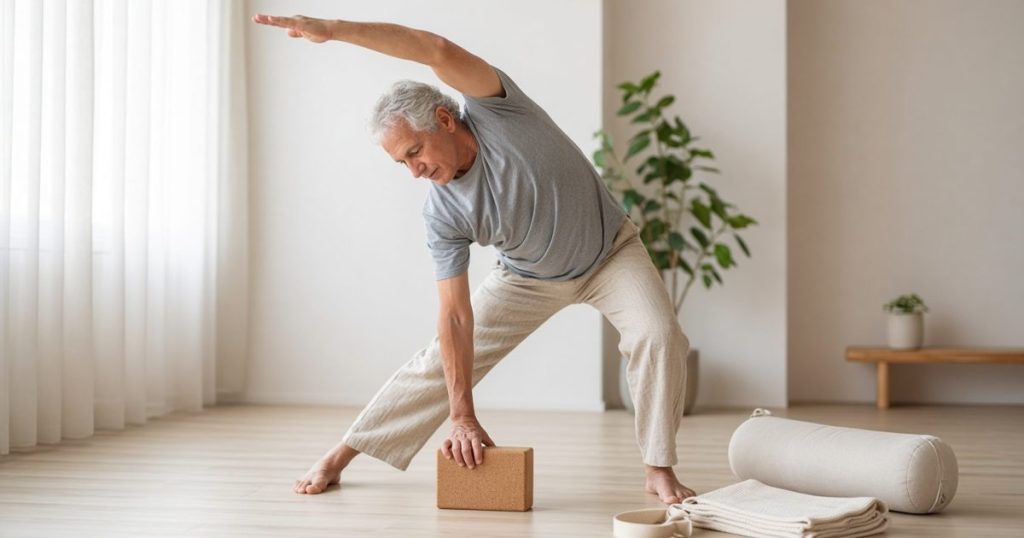
Blocks are firm foam or cork rectangles. Place a block under your hand in standing poses so you do not have to reach all the way to the floor. Sit on a block to lift your hips if sitting cross-legged is uncomfortable. Blocks can be used on three heights: flat, on their side or standing tall. Household substitute: a sturdy hardcover book or two, wrapped in a towel to prevent slipping.
Straps
A strap is a long band, usually with a buckle, that extends your reach. If you cannot hold your foot in a seated stretch, loop the strap around the arch and hold the ends. Household substitute: a bathrobe belt, a necktie or a long, non-stretchy scarf.
Blankets and towels
Folded blankets are wonderfully versatile. Fold one to pad a hard floor under your knees, roll one to support your ankles or lower back, or sit on one to lift your hips. Household substitute: a firm bath towel folded in thirds.
Bolsters and pillows
A bolster is a firm, cylindrical or rectangular cushion used in restorative poses. You can rest your legs or back on it to relax fully. Household substitute: two or three firm couch cushions stacked, or a rolled blanket.
The yoga mat
A mat gives you a non-slip, cushioned surface. See our guide on choosing a yoga mat.
Simple ways to use props
Seated forward bend with a strap. Sit tall on the edge of a chair with your feet on the floor. If you want to reach forward, loop a strap around the soles of your shoes and hold the ends while you lean forward gently.
Standing stretch with a block. Stand with feet hip-width and place a block on the floor in front of you. Hinge from the hips and rest your hand on the block, keeping your knees soft.
Supported rest. Lie on your back with your calves resting on a chair seat or stacked cushions, hands on your belly. Breathe for a few minutes. Skip this if you cannot comfortably lie flat, or if you have been advised to avoid it.
Wall support for balance. Stand sideways next to a wall with your hand resting on it. Practice shifting weight from one foot to the other. Our balance practices include more ideas.
Prop safety checklist
- Use props on a firm, non-slip surface, never on a slippery floor.
- Choose items that will not slide, wobble or collapse under your weight.
- Do not stand on props, and do not use chairs with wheels or rocking legs.
- Keep the area free of clutter, pets and trip hazards.
- Check that straps and belts are in good condition.
- If something feels unstable, stop and adjust.
Do I need to buy anything?
No. Start with a chair, a wall, and a few towels or books from around the house. If you enjoy yoga and decide to buy equipment, look for items sold in sporting goods stores, community centers or online, and compare materials and prices. We do not sell products or recommend specific brands. See our Advertising Disclosure.
Next steps
Ask your instructor to show you how to use props in class. If you are practicing at home, start with one prop at a time. For beginner confidence, read Yoga After 60: A Gentle Beginner's Guide, and if you want to practice with others, see how to find a class near you.
The best prop is the one that helps you enjoy the movement safely.
This article is general educational information from the Sunlit Mat Living Editorial Team. It is not medical advice and is not a substitute for care from your doctor. See our Editorial Policy to learn how we research and update articles.